More than 8,000 doctoral researchers conduct research within the Helmholtz Association, but only a few are honored with the Helmholtz Doctoral Prize. Upon the 11 winners is Dr. Katrin Geng from Helmholtz Institute Ulm. Under the supervision of Dominic Bresser, award winner Dr. Katrin Geng worked on solutions to the existing safety and stability problems of lithium-metal batteries.
Expectations for the commercial rollout of lithium metal batteries are high, especially for electromobility. Lithium metal batteries combine two advantages: they store significantly more energy per unit of weight and volume, which means batteries in electric cars or phones would last longer at the same battery size. Although polymer electrolytes have so far been the only route to successful commercialization of lithium metal batteries, the reactions at the contact point between the lithium electrode and the polymer are still insufficiently understood. This interface determines how safe and long-lived a battery is.
In her doctoral thesis at the Helmholtz Institute Ulm, Geng investigated the interfacial reactions in polymer-based solid-state electrolytes and succeeded in influencing them in a targeted way.
On November 6, 2026, the scientist Dr. Katrin Geng was awarded the Helmholtz Doctoral Prize, endowed with around €5,000, alongside 10 other outstanding doctoral researchers.
“I am very happy about this special award. It is wonderful that, through my research on safe and high-performance battery storage, I was able to contribute to the energy transition. At the Helmholtz Institute Ulm, the excellent facilities and the freedom my doctoral supervisor Dominic Bresser gave me allowed me to advance my research in a focused way and find innovative solutions. Working closely with international scientists was especially enjoyable. I hope this prize is also an incentive for other young women: science is cool! Let’s go!”
With her work, the scientist managed to close a long-standing methodological gap and create a reliable measurement method for comparing interfacial reactions with polymer electrolyte materials. A stable foundation for developing safe batteries supports Europe’s industrial competitiveness and sovereignty.
Geng developed and validated a reliable procedure for determining charge-transfer resistance and analyzed its influence on the reversible deposition and dissolution of lithium. In addition, she clarified how the mechanical properties of the polymer electrolyte affect the shape and structure of lithium deposition. Her results deepen the understanding of this crucial interface and provide important starting points for developing safe and high-performance lithium metal batteries.
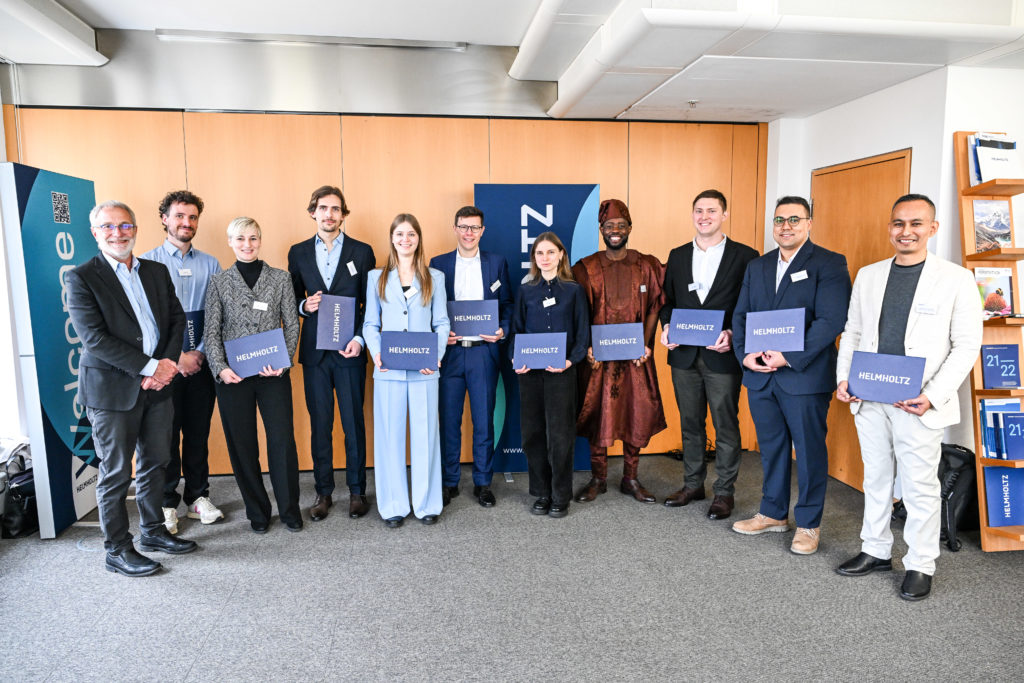
📸 Oliver Walterscheid
Helmholtz Doctoral Prize
Annual award of the Helmholtz Association for the best doctoral theses in the six research fields of the Helmholtz Association
Dr. Katrin Geng
Dr. Katrin Geng first studied Chemistry and Business Chemistry at Ulm University, including stays abroad at Imperial College London and Chalmers University of Technology in Gothenburg, and then completed her doctorate at the Helmholtz Institute Ulm for Electrochemical Energy Storage (HIU). During her doctoral studies, she successfully advanced interdisciplinary collaborations with international partners to specifically enrich her experimental research.
Dominic Bresser
Dominic Bresser earned his doctorate at the MEET Battery Research Center in Münster. Since 2020, he has headed the research group “Electrochemical Energy Storage Materials” at the Helmholtz Institute Ulm. In 2022, he received the prestigious ERC Starting Grant from the European Research Council for the development of novel electrode materials.