HIU-Newsletter
You a scientist yourself? A journalist, a political decision-maker or business representative? In our newsletters we compile the latest battery research news for you. Specially tailored to your personal area of interest.

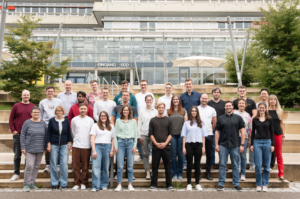
The research group of Prof. Dr. Birgit Esser focuses on functional organic molecules and materials. The main topics are organic-based batteries, strained ring systems (chemical rings with high ring strain), and photocatalysis (chemical reactions driven by light in the presence of a catalyst).
Organic Batteries:
Organic electrode materials are promising for sustainable batteries, as they are made from readily available, mostly non-toxic elements and can be flexibly designed. Their diverse redox chemistry enables their use in different battery types, for example with sodium, aluminum, or magnesium. The research develops and investigates such materials and how they function.
Strained Ring Systems:
Nanohoops are ring-shaped molecules with unique electronic properties. Various variants, such as chiral or redox-active structures are under investigation as well as the analyzis of their physical and chemical properties. The group explores their potential for applications, for example in batteries or spintronics.
Photocatalysis:
The group focuses on organic dyes as photosensitizers for light-driven reactions, such as hydrogen evolution. A particular interest lies on donor-acceptor systems and their combination with catalysts. The aim is to enable more efficient reactions under milder conditions.
The research group of Prof. Dr. Birgit Esser focuses on functional organic molecules and materials. The main topics are organic-based batteries, strained ring systems (chemical rings with high ring strain), and photocatalysis (chemical reactions driven by light in the presence of a catalyst).
Organic Batteries:
Organic electrode materials are promising for sustainable batteries, as they are made from readily available, mostly non-toxic elements and can be flexibly designed. Their diverse redox chemistry enables their use in different battery types, for example with sodium, aluminum, or magnesium. The research develops and investigates such materials and how they function.
Strained Ring Systems:
Nanohoops are ring-shaped molecules with unique electronic properties. Various variants, such as chiral or redox-active structures are under investigation as well as the analyzis of their physical and chemical properties. The group explores their potential for applications, for example in batteries or spintronics.
Photocatalysis:
The group focuses on organic dyes as photosensitizers for light-driven reactions, such as hydrogen evolution. A particular interest lies on donor-acceptor systems and their combination with catalysts. The aim is to enable more efficient reactions under milder conditions.
 Prof. Dr. Birgit Esser EsserLab - Organic Functional Materials Mail: birgit.esser[at]uni-ulm.de