July 27th, 2021
Battery researcher Dr. Matthias Künzel, scientist at the HIU and member of the research group Electrochemistry for Batteries, was recently awarded two research prizes. Last month he was awarded the Ecology Prize of the Viktor-und-Sigrid-Dulger Foundation issued by the Heidelberg Academy of Sciences. On July 27th, the Gips-Schüle Young Talent Award followed, at which Dr. Künzel was one of four honored doctoral students. Künzel was the award winner in the category “Technical Sciences”. The HIU scientist received both prizes for his doctoral thesis.
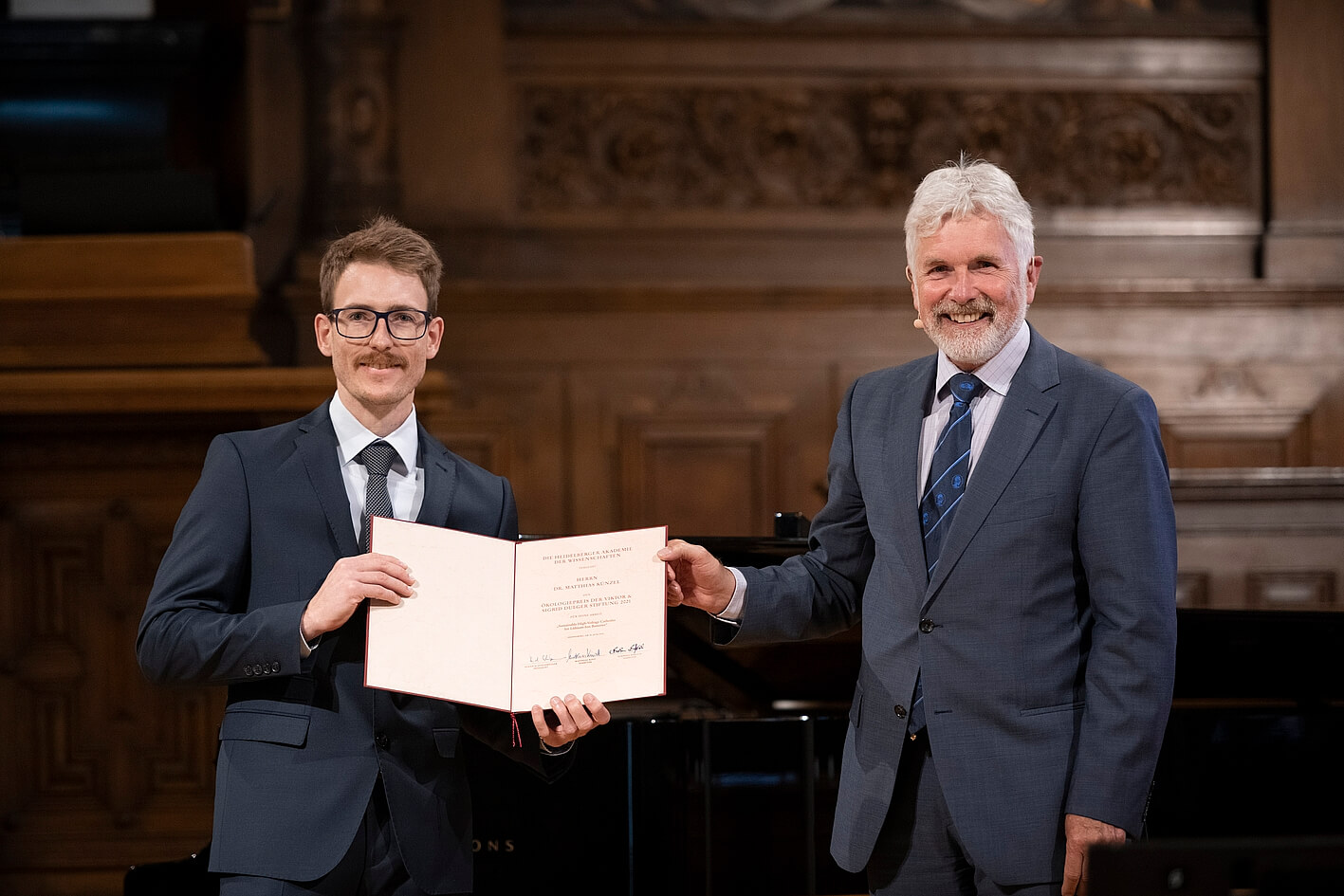
Ecology Prize of the Viktor-und-Sigrid-Dulger Foundation
The Viktor-und-Sigrid-Dulger-Stiftung’s Ecology Prize is intended to promote scientific work in the humanities, social sciences, natural sciences and engineering that deal with environmental problems and their solutions. In 2021 the award went to Künzel. In his excellent work “Sustainable High-Voltage Cathodes for Lithium-Ion Batteries”, he researched the production of sustainable lithium-ion batteries.
In particular, it was about the problem of developing high-voltage lithium-ion cathodes that can do without the critical resource cobalt, as this is not only toxic, expensive and very rare, but also essentially under inhumane conditions in politically unstable regions the world is degraded. In addition, it was possible for this system to replace toxic and environmentally harmful materials such as solvents and fluorinated binders in battery electrode production with water and naturally occurring biomaterials, so that the entire production process will not only be cheaper in the future, but above all more environmentally friendly.
Gips-Schüle Young Talent Award 2021
The Gips-Schüle Foundation promotes research, young talent and teaching in Baden-Württemberg. The focus is on the MINT subjects (mathematics, computer science, natural science and technology) as well as on interdisciplinary projects. In its sphere of activity, Baden-Württemberg, the Stuttgart Foundation works closely with universities and research institutions and enables future-oriented research projects to be carried out.
The reason for the Gips-Schüle Young Talent Award for Dr. Künzel sounds similar to that of the Heidelberg Academy of Sciences: Accordingly, the sustainability of the lithium-ion batteries was also in the foreground.
It was also emphasized that Dr. With his work on the implementation of aqueous electrode production techniques for lithium-ion cathodes, Künzel could solve an equally important environmental problem in battery production. It was possible to replace toxic and environmentally harmful materials such as solvents and fluorinated binders in battery electrode production with water and naturally occurring biomaterials, so that the entire production process will not only be cheaper in the future, but above all more environmentally friendly.
In a follow-up project, the Helmholtz Institute Ulm is currently working with its partners on transferring the knowledge gained to production in a pilot line. For this forward-looking research, Dr. Künzel received this year’s award in the technical sciences category.
In the future, Dr. Künzel continues to research the sustainability of lithium-ion batteries with innovative recycling concepts. The aim of the work is that the individual materials can be made directly usable again, instead of simply melting down entire battery cells and recovering only a few valuable metals.
Further Information:
https://www.hadw-bw.de/news/ausgezeichnet-sechs-junge-forschende-erhalten-preise-von-der-akademie
https://www.hadw-bw.de/die-akademiepreise/preisverleihung