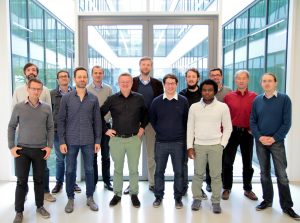
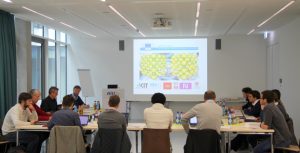
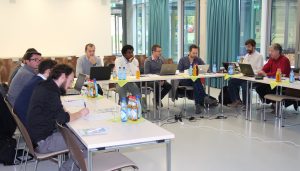
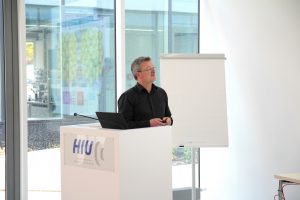
July 2nd – 5th, 2017, Bad Honnef, Germany
Organizing Committee
Dr. Roswitha Zeis
Karlsruhe Institute of Technology
Institute of Physical Chemistry and Helmholtz Institute Ulm
Ulm, Germany
Prof. Dr. Aimy Bazylak
Department of Mechanical and Industrial Engineering
University of Toronto and Institute for Sustainable Energy
Faculty of Applied Science and Engineering
University of Toronto
Toronto, Canada
Dr. Ludwig Jörissen
Center for Solar Energy and Hydrogen Research Baden-Württemberg
Ulm, Germany
Scope
The Next Generation Polymer Electrolyte Membrane Fuel Cell Heraeus Seminar will be a 4-day meeting for polymer electrolyte membrane (PEM) fuel cell experts to participate in engaging discussions about the state of the art of the technology and to strategize the next steps to overcoming the key barriers to widespread commercialization.
We have assembled a group of internationally recognized experts in PEM fuel cells to deliver invited seminars on their state-of-the-art research, and in particular, they will lead discussions to uncover the key challenges and areas of opportunities that are on the horizon. We are taking a true multiscale approach to this meeting, as our speakers will cover topics from the stack level right down to the nanoscale transport in the catalyst layer and membrane.
Our key objective for this candid meeting-of-the-minds is to forge new international, multidisciplinary partnerships in order to collaboratively tackle the most challenging issues facing fuel cell technologies today. By forging these new partnerships, we have the opportunity to accelerate our collective progress in advancing fuel cell technologies and achieving international energy sustainability.
21.11.2019, 09:30 AM – 5:00 PM
The Helmholtz Institute Ulm (HIU) and the Helmholtz Institute Münster (HI-MS) co-organize the scientific workshop “Theory Meets Experiment” in Ulm.
Venue:
Helmholtz Institute Ulm
Electrochemical Energy Storage (HIU)
Helmholtzstraße 11
89081 Ulm
Online-Registration
Event Flyer
Participants limit: 80 persons
Registration: free of charge
6 – 9 October 2019
Advanced Lithium Batteries for Automobile Applications (ABAA12) Conference 2019
Venue
Maritim Hotel Ulm
Basteistraße 40
89073 Ulm
27-28 September 2018,
Maritim Hotel,
in Ulm, Germany
Magnesium batteries have attracted considerable attention
by international research activities, because
magnesium offers a number of attractive features for
future batteries. The metal anode has nearly double
the volumetric capacity of lithium metal, at a negative
reduction potential of -2.37 Vs SHE. Moreover,
a significant advantage of magnesium is the lack of
dendrite formation during charging, which overcomes
major safety challenges encountered with using
lithium metal anodes. Several breakthroughs were
achieved and important progress has been made in
the last years, in particular in the development of
electrolytes with mild chemistry and high efficiency
and in the development of first conversion and intercalation-
type cathodes. First fundamental studies
have elucidated mechanisms of Mg intercalation or
chemical interaction of the electrolyte with the electrodes.
The 2nd International Symposium on Magnesium
Batteries addresses the research community in
this rapidly growing field. It is the aim of the symposium
to present and discuss the recent state-ofthe
art and the progress in the field. There will be
enough time for discussion of questions or controversial
issues in the topic.
21-22 July 2016,
Tagungszentrum Blaubeuren,
in Ulm/Blautal, Germany
Magnesium batteries have attracted considerable attention
by international research activities, because
magnesium offers a number of attractive features for
future batteries. The metal anode has nearly double
the volumetric capacity of lithium metal, at a negative
reduction potential of -2.37 Vs SHE. Moreover,
a significant advantage of magnesium is the lack of
dendrite formation during charging, which overcomes
major safety challenges encountered with using
lithium metal anodes. Several breakthroughs were
achieved and important progress has been made in
the last years, in particular in the development of
electrolytes with mild chemistry and high efficiency
and in the development of first conversion and intercalation-
type cathodes. First fundamental studies
have elucidated mechanisms of Mg intercalation or
chemical interaction of the electrolyte with the electrodes.
The 1st International Symposium on Magnesium
Batteries addresses the research community in
this rapidly growing field. It is the aim of the symposium
to present and discuss the recent state-ofthe
art and the progress in the field. There will be
enough time for discussion of questions or controversial
issues in the topic.
27th July 2015
Ulm, Germany
LISSEN is a large scale collaborative project, funded by the European Union Seventh Framework Programme (FP7), which aims to identify and develop nanostructured electrode and electrolyte materials to promote practical implementation of the very high energy lithium-sulphur battery.
The project is directed to the definition and testing of a new, lithium metal-free battery configuration based on the use of lithiated silicon as the anode and a nanostructured sulfur-carbon composite as the cathode. Such battery can offer an energy density at least three times higher than that available from the present lithium battery technology, a comparatively long cycle life, a much lower cost (replacement of cobalt-based with a sulfur-based cathode) and a high safety degree (no use of lithium metal).
The leading scientists and the representatives of industry will present their latest results.
Invited speakers
Prof. Dr. Maximilian Fichtner, HIU-KIT (Germany)
“Recent progress in the development of Mg-S and Li-S cells”
Dr. Klaus Leitner, BASF (Germany)
“What is the future of lithium-sulfur batteries? A brief discussion of potential issues and hurdles”
Dr. Holger Althues, Fraunhofer IWS (Germany)
“Carbon materials for enhanced sulfur cathodes”
Prof. Dr. Diana Golodnitsky, TAU (Israel)
“Facile synthesis and characterization of novel solid polymer-in-ceramic electrolyte”
Dr. Stefan Koller, VARTA Micro Innovation GmbH (Austria)
“Si anodes for Li-ion batteries”
Dr. Yuichi Aihara, Samsung R&D Institute (Japan)
“All Solid State Li-Sulfur Battery using a Li3PS4 Ionic Conductor”
The 14th UECT (Ulm ElectroChemical Talks) took place in the Congress center Ulm from June 23 – 26, 2014. The 2014 talks focused on the topic of “Next Generation Electrochemical Energy Technologies”. The conference has been staffed by top class international speaker. HIU was a co-organiser.
In the seminar of the Helmholtz Institute Ulm (HIU), outstanding international battery researchers share their scientific findings and technological inventions with scientists and students in Ulm. The seminar takes place every Tuesday at 2 pm during the lecture period.
20.10.2020
Dr. Martin Finsterbuch
Forschungszentrum Jülich, Jülich (online)
27.10.2020
Dr. Yvonne Grunder
University of Liverpool, Liverpool (online)
03.11.2020
Prof. Enrico Bodo
University of Rome, Rome (present at HIU)
10.11.2020
Dr. Holger Althues
Abteilung Chemische Oberflächen- und Batterietechnik, Fraunhofer-Institut für Werkstoff- und Strahltechnik, Dresden (online)
26.11.2020
Dr. Marion Chandesris
CEA Liten, Grenoble (online)
2021
09.02.2021
Martin Bazant
MIT
11.02.2021
Dr. Christina Iojoiu
LEPMI, Grenoble
16.02.2021
Kinberly See
Caltech
The Ulm Battery Conference ABAA12 (Advanced Lithium Batteries for Automobile Applications) was drawing to a close as the message from Stockholm spread in the audience. A conference participant had just been awarded the Nobel Prize on the same morning.
Spontaneous jubilation, standing ovations and applause for the newly awarded winner: M. Stanley Whittingham – who himself had been informed of his award just a few minutes earlier by a telefphone call – sat calmly in the audience of the ABAA12 conference, when the news went around the world. He was honored with this year’s Nobel Prize for Chemistry at 11:45 am with John B. Goodenough and Akira Yoshino for inventing the lithium-ion battery.
Stanley Whittingham was considered one of the earliest lithium battery researchers worldwide. These lithium-ion batteries are today in almost all portable electrical appliances, e-cars and stationary storages. His personal research contribution was a whole series of material innovations: Not only were the lithium batteries much lighter than their predecessors, they could also be re-charged and discharged many times.
Whittingham developed the first functional lithium battery in the early 1970s. Goodenough was responsible for the development of much more powerful batteries. Yoshino in 1985 produced the first commercially available lithium-ion battery.
The ABAA12 Conference is an international conference with changing venues on every continent. The conference was hosted by Margret Wohlfahrt-Mehrens (ZSW), Prof. Stefano Passerini (HIU) and Dr. med. Khalil Amine (IALB / Argonne National Laboratory, USA).
The ABAA12 conference is unique compared to other congress formats. The ABAA12 provides a substantial connection between science, industry and politics. Around 380 participants from 30 nations – including renowned scientists, policymakers and representatives of the automotive industry – debated over four days on current trends of lithium-ion batteries.
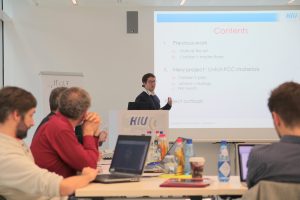
Representatives of five European research institutions (the HIU, the French Alternative Energies and Atomic Energy Commission, the Technical University of Denmark, the Swedish Uppsala University and the Slovenian Kemijski Institute) met at HIU for the kick-off of the EU funded project „LiRichFCC” which promotes the investigation of novel concepts for cathode materials for Li-ion batteries.
Recently HIU-scientists developed a new cathode material based on a new storage principle, as a result of which energy storage densities can be increased beyond those of systems known so far. Instead of storing lithium ions by intercalation into a stable host, lithium ions are populating and vacating lattice sites of the material itself. It is the aim of the project to explore and optimize possible compositions, synthesis methods, structural properties and dynamics of Li-rich FCC materials through an interdisciplinary approach involving predictive computational work, advanced chemical synthesis and high-end characterization. An important focus of the project will further be to evaluate the use of these materials for electrical energy storage and to identify potential other uses for Li-rich FCC materials that cannot be foreseen today. This new principle allows for unprecedented energy and power density compared to other battery materials and may revolutionize the use of batteries in applications involving a need for supplying large amounts of energy and power from small spaces.
The EU promotes collaborations between international partners by funding up to five million Euro and up to four years by means of the instrument „Research & Innovation Action“ (RIA). With the slogan “New ideas for radically new future technologies” the EU was searching for cutting-edge projects within the EU framework programme “Horizon 2020”. The „LiRichFCC” project, coordinated by Maximilian Fichtner and Christian Punckt of the network NanoMat, was one among 13 RIA proposals out of overall 800 which were selected by the EU.